We’re quite often asked for our specific feedback after spending some time cruising on Rush. Here’s a download – probably mainly of interest to those considering or commissioning a boat.
Overall performance
Rush is comfortably quick.
We recently sailed a fat upwind leg in 18 TWS, at 10 + boatspeed and a week later absolutely horizon job’d a well sailed (albeit slightly smaller) monohull on a beat. We sailed bigger angles and tacked on a few shifts in idyllic, 13 TWS, conditions.
In a demonstration of passage speed, in July we sat in a café at the top of Lakka bay on Paxos, waiting for signs of the afternoon breeze. They appeared at 12.00, so we paid the bill, took Derek back to Rush and lifted him, raised anchor and negotiated the hundred other boats in the bay, hoisted, trickled down the lee of Paxos and then smoked the rest of the passage to Lefkada swing bridge, making it with 10 minutes to spare for the 17.00 opening. Under five hours from drinking coffee in the café to completing the almost 40 mile passage, in 10 to 15 knots of breeze.
All this, of course, fully loaded with our cruising gear, water, diesel, spares, food etc. Meaningfully different from typical boat-test set-up.
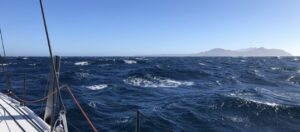
One of the best attributes, is that Rush has great motion upwind. Never slams. Pretty exceptional for a cat, we gather. It’s a sharper motion than most monohulls, but that seems easier on my stomach than wallowing. Being level, and with the pilot steering, we just hang out while keeping an eye on the numbers. Downwind is smooth. No water on deck – not even on the forward cross-beam. If the bows go into a wave, they’re so fine the boat decelerates gradually and then the increasing buoyancy from the “chamfer” panels (upper areas on the inside faces of the topsides) lifts them again.
Boat handling
It has taken time to get that efficient, well sorted feel that sailors from a racing background are accustomed to. A new boat inevitably needs minor tweaks – and we’ve also been gaining multihull familiarity. We’re enjoying it coming together – albeit there’s definitely more to learn, especially in bigger conditions.
Multiple tweaks add up to a big difference – here are a few we made:
Line stowage – line lengths – swapping one or two to more flexible rope.
Stowing deck equipment in relevant places for quick access when required.
Marking the main halyard and reef lines so we know set points.
Acetyl wear strips to reduce line friction over the side-deck.
Solent furler line re-lead for cleaner exit from the drum.
Antal rings on Karver 2:1 halyard swivels – see below
Working out our procedures (manoeuvres – hosts & drops – reefing etc)
Rush’s decks are big and flat so moving around and working the boat feels safe and uncluttered.
Towards the end of Mark and Liz’s time with us, we turned downwind – opened a bridge deck locker – connected the G1 asymmetric – hoisted and unfurled – a few minutes from start to finish. Mark (who coaches the British Olympic Sailing Team) commented “Setting the kite takes longer on Ragdoll” (their 28ft classic).
Reef hooks
Initially we had doubts. The reef hooks are great once set – no chafe or stretch – but getting them to engage was an issue. I think we’re now fans – although perhaps still limited in experience.
Key elements to making the system work well:
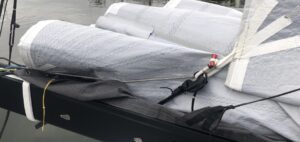
Dyneema dog-bone loops attached to the mainsail leech (see photo)
– fitted so the loops are held “open” not pinched closed (which happens if you cow hitch them).
These loops can be removed, making removing the mainsail without un-reeving the reef lines, simple.
Adjusting the strop lengths, attaching the reef hooks to the boom.
Filing down the hooks to remove shoulders that caught as the hooks tried to engage in the loops.
Marking the lines at correct settings.
We set up Rush so the luff reef line leads to the electric winch on one side – the leech line to the other
– we can pull down luff and leech (a finger and button exercise) from the helm on either side with full visibility.
The procedure we find works best:
Ease the main halyard to its relevant reef position mark
Pull down the luff and leech together
Before the luff is fully down, tension the leech line until the reef hook engages
Finish by tensioning the luff line
I gather a number of cruising sailors give up and go back to conventional reefing lines, whereas racing sailors swear by the hooks.
Our advice – attend to the details and persevere.
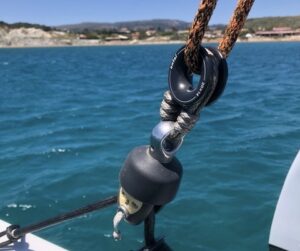
Karver 2:1 halyard swivels
We chose Karver KF furlers and swivels for our staysail and code / asymmetric offwind sails. Karver equipment is up there with the best (albeit expensive) – a popular choice by IMOCA and Class 40 fleets, etc.
However… we opted for their basic top swivel, which has a simple stainless eye on the top for the halyard (rather than a block). The friction made the sails hard work to hoist and drop and worse, the added loads tended to make the 2:1 halyards twist and jamb.
During a phone chat, Greg in SA suggested adding an Antal ring to reduce the friction. See photo.
Such a simple thing…. Total transformation. Maybe the swivel was always intended to have a ring or block lashed to it!
Anyway, it’s now easy to hoist and, after use, the sails just drop onto the tramps.
Solar Panels
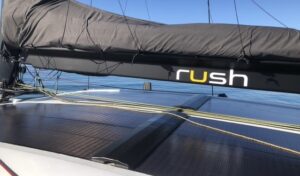
I ran through our choice of MIPV thin film technology in an early blog post and we were very happy with their performance. All the low-light, partial shaded efficiency claims seem to be true. However, we chose their option of cable connections underneath, giving a smart, fully flush finish. Without trying to explain exactly why that choice didn’t fit well on our boat (due to the locations where it’s possible to lead the cables through the roof), this led to water creeping along the cables and corroding the terminals… so the panels failed.
The only solution was to replace the panels. They’re bonded to the roof and it’s not possible to remove them intact. So, this spring Amanda and I removed the old panels (a seriously tough job), Claire arrived in time to help bond on the new ones (top mounted connectors this time) and Clarence came from South Africa to re-wire. I made composite covers for the plugs and cables to protect / smarten it all.
We’re now super-happy with the panels. OK, we’re in Med conditions (so not the toughest test), but we run all the boat’s systems, including electric cooking, watermaker, hot water, fridges and freezer, as well as all the sailing equipment – and the batteries haven’t dropped below 80%. They’re usually fully charged again by 9am, without giving any consideration to moving the boom or lines to minimise shading. And the panels are walkable, light and don’t lose efficiency when hot. Seriously impressive.
Watermaker
Our Shenker Zen watermaker has also become a favourite bit of kit, also following a slightly shaky start. The pressure tank had a leak at the outset and, separately, the pressure sensor failed. Signature, the SA supplier, organised replacement parts to be sent to us direct from Schenker in Italy – both companies acted swiftly and efficiently. The watermaker is currently getting loads of use – multiple showers after swimming for multiple people every day, fresh water flush toilets and the washing machine being the major consumers.
Feels really cool to make all our electricity from the sun and all our water from the sea.
That said, we would like to have a sea water flush option on one of the toilets (with a simple Y valve to switch from fresh to salt) and will get around to it sometime. There’s a seacock nearby we can tap into. Just seems a good back-up and would lessen watermaker time.
Washing machine
The Daewoo Mini is a winner. For anyone debating whether to fit one or not – do it! Well worth the 18kg! The drain hose on ours was overlength and had a loop that tended to trap water and cause a program error. Hose shortened, the machine works perfectly.
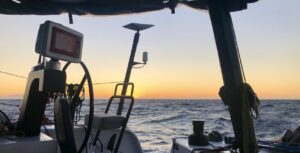
B&G System
We’re fans of B&G electronics and are very happy with our set-up.
We did, however, have a Zeus plotter fail on our last boat (after three years) and read comments online indicating that its best to protect them from strong sunlight when possible. Similarly, an H5000 pilot controller at one of Rush’s helms stopped working after getting very hot in the sun earlier this year. It came back to life a few hours later after cooling off. So, keeping the instruments out of the sun has become an automatic process and one we’d recommend.
The Scanstrut rotating pods on Rush make protecting the plotters easy underway. We generally have the plotter on the sunny side pointing into the cockpit, away from the sun. We put the covers over the pilot controllers if they’re in direct strong sunlight, and fanatically put all the covers on (including fabric pedestal covers) as soon as the anchor is down.
General living aboard
I’ll try not to bang on again too much. General living on board Rush is, in our terms anyway, almost ridiculously comfortable. We’re blown away by the feeling of light and space through the cockpit and saloon. The open, airiness makes visitors from more voluminous catamarans stop in their tracks. We love hanging out afloat in a sleek apartment, with 360 views, without feeling on top of each other, even with visitors aboard.
The space in the hulls, where all we really do is sleep and go to the loo, is significantly smaller than in the high volume cats, but it’s larger than you’d probably expect and more than enough for us.
We have less locker space than those boats, yet we still have a number of empty lockers. We could have specified more furniture in unused areas, particularly in the owner’s hull, but we wanted to keep Rush light and we all know that most of us gradually expand to fill the space available!
Overall
People ask what we’d do differently and, other than one or two minor details, we can’t think of anything significant – so far.
All boats are compromises but we’re loving Rush’s combination of sailing capability and live-aboard comfort. So that’s pretty cool – and quite a relief!
Winterising error
I promised elsewhere that I’d confess to a wintering error – this is it..
When we returned to Rush in late March, after she’d spent the winter ashore, I discovered a huge pool of diesel in the port engine bay.
After much searching it transpired that after servicing the engines just before Rush was lifted in November, I must have over-tightened the fuel pre-filter and the water separator glass bowl under it had a hairline crack…. hidden on the bulkhead side, of course. Four and a half months of slight seepage equals, it seems, 90 litres (!!) of diesel in the bottom of the boat…. The real error – I should have turned the diesel off at the tanks (located in the bridge deck, higher than the engines) before leaving.
We were lucky. Another week or two and the diesel would have risen above cabin floor level. As it was, the bay is deep and sealed, so the diesel was contained. We keep the bays clean (ironically, so that even a small fluid leak is easy to spot) so were able to pump the diesel into a can and filter it back into the tank. Then undertake a mammoth clean-up job.