South Africa – February ’23
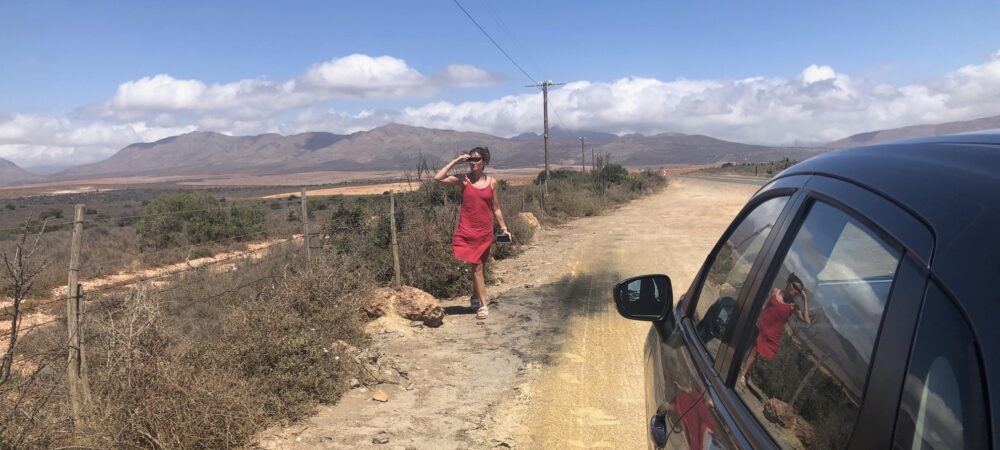
In mid Feb we headed off on Amanda’s planned diverse five day road trip. An hour’s drive from Knysna the Outeniqua Pass climbs over the mountains above the town of George, on the Garden Route. The pass was originally created in 1847 (and known as the Montagu Pass), as a trade route inland from the coast, for horses and wagons. It was one of those hard-to-comprehend projects that took a significant toll. It has since been re-routed, re-built and re-named as technology, machinery and vehicles have evolved. After driving back and forth along the N2 (between the mountains and the coast) several times it was exciting to head into a landscape that had only been a dramatic backdrop until then. We’re going to run out of superlatives if not careful, so let’s just say the pass has steep, lush, green and rocky slopes (a bit like Scotland on steroids) with huge views down over George at the foot and on towards the Indian Ocean. It’s often shrouded in the clouds but we lucked out with a crystal clear conditions. The pass leads into the Karoo – a sort of cross between desert and rocky flatland pastures. The Karoo is hotter and drier than the coastal areas – over 30°C when we were there, with huge plains and red rocks. In the Outeniqua region the Karoo is also home to ostrich farms on, of course, another grand scale. Ostrich generated wealth through their meat, leather and, it now seems… monster feather dusters. Locals sell them on street corners in the ostrich capital Oudshoorn and we wanted one, but it would be a touch unecessary on a catamaran. Next stop was the spectacular limestone Cango Caves - one of the world’s longest and largest cave systems and it’s best to let the photos do most of the talking. The stalactites and stalagmites have formed over millions of years and, of course, in caves they’re not subject to erosion or other degradation. Standing next to these incredible formations, in cathedral sized galleries, put us and our lifespans into perspective. From the caves we drove along Route 62 which, like Route 66 in the States, has its own T-shirts, mugs and tea towels. It’s justifiably renowned. The best stretch came the following day, so we’ll jump to our first night’s stay. Amanda had found a converted old, seriously rustic barn on an olive farm in the middle of… nowhere. Let’s hope Avis don’t read this blog because off-road use of the car was banned (how’s that ever going to work in Africa?). By the time we tracked down our barn the car was an indistinguishable dusty lump. Mountains towered above the barn on one side, with huge views over the karoo on the other. Utter silence. We wandered around the olive trees, cooked a braai (South Africans tend to burn wood rather than charcoal, so you have to light it long before you’re hungry) and lay on stone benches gazing at…